Latest

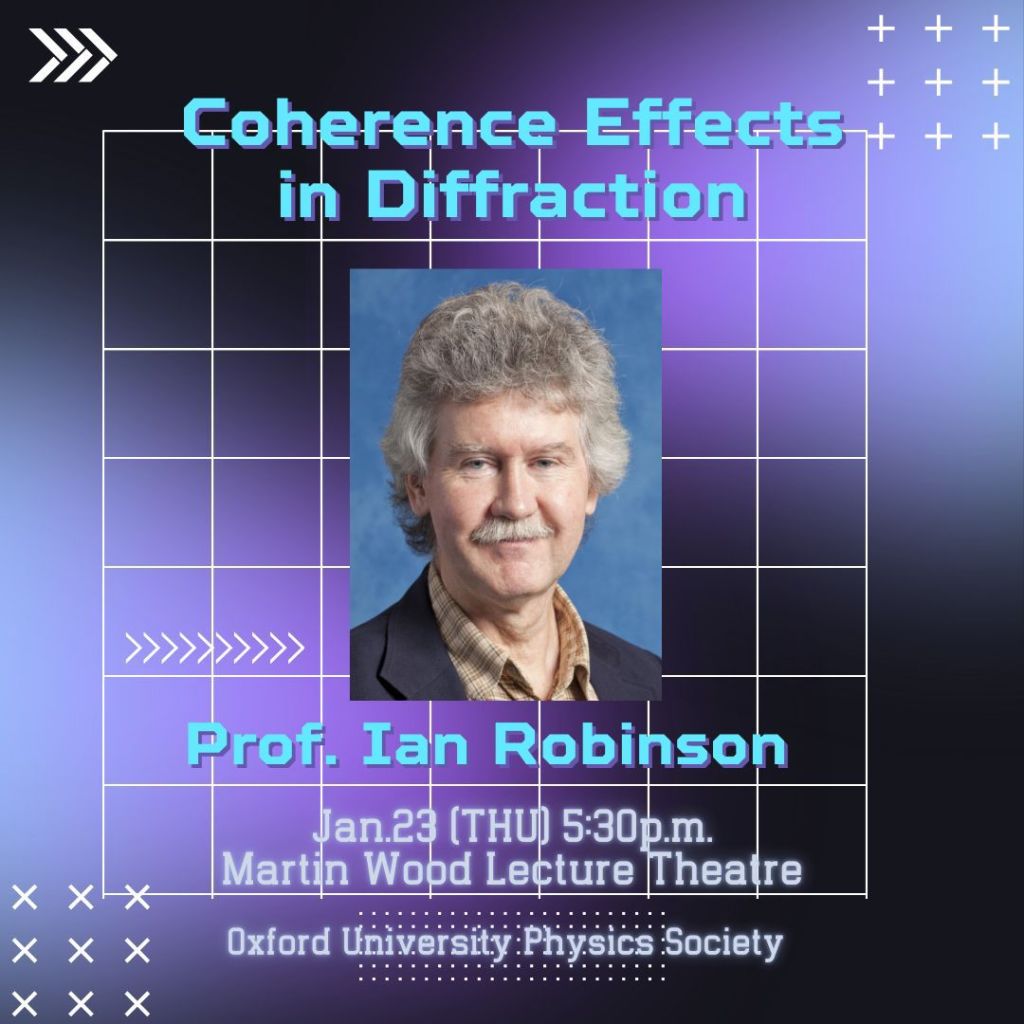
PROF. IAN ROBINSON: COHERENCE EFFECTS IN DIFFRACCTION

Join us Thursday (22/01/2025) evening at 17:30 in the Martin Wood Lecture Theatre for a talk by Prof. Ian Robinson from the condesnsed matter group.

Ian Robinson is a professor at the London Centre for Nanotechnology, UCL. He uses X-ray diffraction to study the structure of materials. His research is currently focussed on the development of coherent X-ray diffraction methods for imaging the structure of nanoparticles and domain structures in larger crystals. The X-ray coherence leads to interference effects in the diffraction patterns which can be inverted, using phase retrieval methods, to 3D images. His research makes extensive use of synchrotron radiation facilities and Free-Electron Lasers with a big activity at the Diamond Light Source. Historically, the earliest beamlines were used to discover Crystal Truncation Rods, opening the field of surface structure determination, for which Robinson was awarded the Surface Structure Prize in 2011 and the Gregori Aminoff Prize in 2015.

PROF. FABIAN ESSLER: QUANTUM INTEGRABLE MODELS

Join us Thursday (21/11/2024) evening at 17:30 in the martin wood lecture Theatre for a talk by Prof. Fabian Essler on quantum integrable models

Message from Prof Fabian Essler:

I’ll assume that the audience is familiar with 2nd year Quantum Mechanics and then discuss a class of many-particle quantum systems that, surprisingly, can be solved exactly (even though the number of particles can be extremely large and they interact very strongly with one another). I’ll explain what makes these systems “integrable”, and discuss some of the “emergent” behaviour they describe (“quantum number fractionalisation”).

If I have time I’ll talk a bit about recent experiments by Google, which investigates the non-equilibrium dynamics of such systems.

PROF. EDWARD DAW: HUNT FOR HALO AXIONS

Join us Thursday evening (14/11/2024) at The Sir Michael Dummett Lecture Theatre in Christ Church for a talk on particel physics.

Prof. Edward Daw will introduce the QSHS experiment searching for axions, a candidate to solve the century old dark matter problem without needing new physics at the electroweak scale. He will also introduce axions and the dark matter problem, and describe the Quantum Sensing for the Hidden Sector experiment which a collaboration of UK Universities and Labs are currently building to search for axionic dark matter.

PROF. TIM WOOLINGS: ATMOSPHERIC PHYSICS (JETSTREAM)

Join us tomorrow night (06/11/2024) at the Martin Wood Lecture Theatre at 17:30 for a talk by Prof. Tim Woolings on atmospheric physics.

Tim Woollings is a Professor in Physical Climate Science at AOPP, specializing in large-scale atmospheric dynamics. His research interests focus on the weather and climate of the mid-latitudes, particularly the behavior of jets, storm tracks, and large-scale regimes such as blocking. He investigates the fundamental understanding of these features, their variability, and their responses to factors like anthropogenic climate change. Recently, his work has emphasized the interaction between mid-latitude dynamics and both tropical and polar regions.

He serves as the Oxford Joint Chair of the Met Office Academic Partnership and collaborates closely with the Met Office on pressing weather and climate issues. He encourages anyone with questions about the Oxford-Met Office collaboration to reach out, as he is dedicated to developing new projects and connections.

Much of Woollings’ research centers around mid-latitude jet streams, which are arguably the most significant weather systems on Earth. For those living in the mid-latitudes, the jet stream is likely the most critical factor influencing their weather and climate. To learn more, he invites readers to check out his new book on the jet stream, written for a general audience.

PROF. ANDRE LUKAS: MACHINE LEARNING AND THEORETICAL PHYSICS

Join us tonight (31/10/2024) at the Martin Wood lecture theatre at 17:30 for a talk by Oxford’s very own Prof. Andre Lukas on the use of machine learning for theoretical physics.

Abstract: “Machine learning and related computational methods have become substantially more powerful and are already applied in many areas of science. In the future, they are likely to change scientific research profoundly. In this talk, Prof. Andre Lukas will be discussing two ways in which machine learning can be helpful in physics: solving differential equations and model building. He will attempt to explain the basic ideas behind these applications and present some recent examples, including inflationary model building, finding string models with certain prescribed properties and computing the masses of fermions from string theory.”